Why Your AI Bill Keeps Climbing Even as AI Gets Cheaper
Why Your AI Bill Keeps Climbing Even as AI Gets Cheaper
When Aditi’s team first started using AI, it costed almost nothing. That was the whole problem.
She runs a ₹300 crore direct-to-consumer skincare brand, four years old, the kind that lives on Instagram, fast shipping, and a content machine that never sleeps. It began with one marketer quietly using ChatGPT to write product descriptions. Thirty pages in an afternoon that used to eat three days. A few hundred rupees. Magic.
Nobody called a meeting about it. It just spread. The support team began drafting replies with it. The performance team spun up ad variants. Someone in Aditi’s own office started summarising market research with it. Seat by seat, tool by tool, each subscription a rounding error next to a single salary. Who flags ₹2,000 a month?
For a while nothing looked wrong. Then the “software and tools” line on the P&L started to twitch. A little that quarter. More the next. By the time finance actually circled it, AI had quietly become one of the fastest-growing costs in the company , rising faster than headcount, faster than ad spend.
Aditi’s first instinct was the one almost everyone has: optimise. Tighten it, cut the waste, move to a cheaper plan. Reasonable. Also not the real question. The thing driving her bill up isn’t waste. It’s the exact feature everyone loves: AI got cheap. This is the story of why cheap AI turns expensive, and how to decide, task by task, when it’s actually worth paying for.
Everything Feels Cheap. So, Why Does the Total Keep Climbing?
Here’s the knot worth untangling slowly, because it’s the part that confuses almost everyone.
You never actually watch the price of AI go up. Just the opposite. Every tool is cheap. Every new seat is a small monthly plan. Every new use looks like a rounding error. And yet, added up across the company, the bill keeps climbing. How are both true at once?
Start with why it’s so cheap in the first place. Behind the scenes, the price of running AI has dropped like a stone. Stanford’s AI Index, the industry’s big annual scorecard, reckons the going rate for a standard chunk of AI work fell from around twenty dollars to about seven cents in two years. You don’t see that number on any invoice. What you see is a ₹2,000-a-month plan that does work, which used to need a person. That cheap plan is what the collapsing rate pays for.
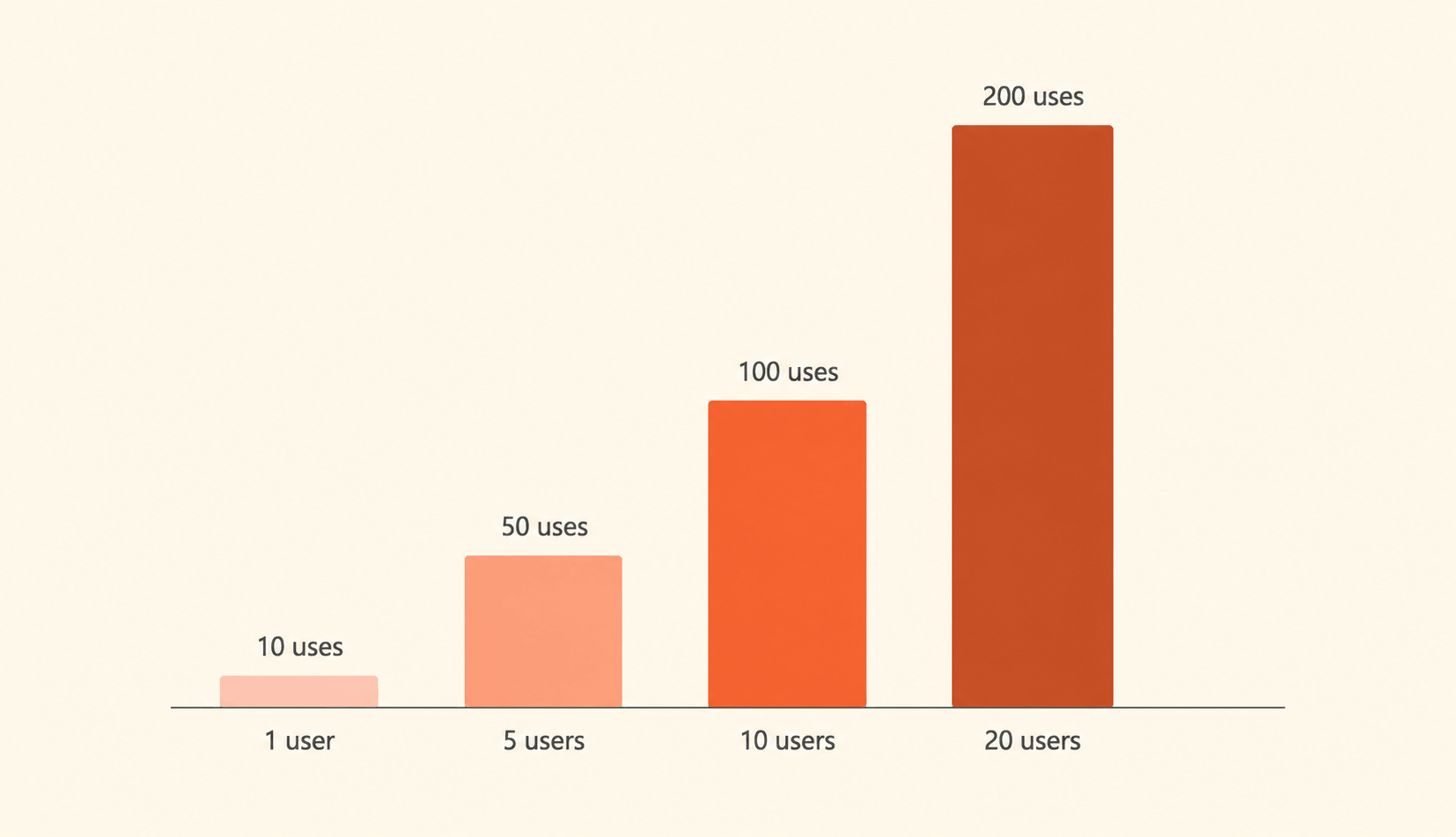
Now watch what “cheap” does to the way people use it. When something feels free, nobody rations it. Aditi’s content lead is the perfect example. She burns through her AI plan’s monthly limit by Wednesday, goes quiet for a few days, then front-loads her big jobs the moment it resets on the Monday. It’s the prepaid data pack shuffle, except for work. And she isn’t unusual; she’s a heavy user. Deloitte, in a 2026 study of enterprise AI costs, found that one person can quietly run up nearly 40 times as much as a casual colleague on the very same tool.
Here’s the part that catches everyone out. Your bill isn’t the price of one use. It’s the price of one use multiplied by how many uses you run. The price per use fell hard, true. But the number of uses rose much harder, from one curious marketer to every team, every day, on everything. When the quantity outruns the falling price, the total goes up, even while each individual use is cheaper than ever. Deloitte watched this happen at one company, where AI usage compounded month after month until it had quietly become more than six million dollars a year that nobody had planned for.
And it doesn’t fix itself, because going back is almost impossible. Once a team works with AI, dropping it feels unthinkable. When Aditi floated “maybe we dial it down,” her content team looked at her like she’d suggested bringing back the fax machine. Writing thirty product pages by hand, answering tickets from a blank screen, that floor is gone. The tool didn’t just make them faster; it reset what “normal” feels like. So usage never drifts back down. It only ratchets up.
The Cheap Price You See Isn't the Real Cost
Now the part almost no one mentions.
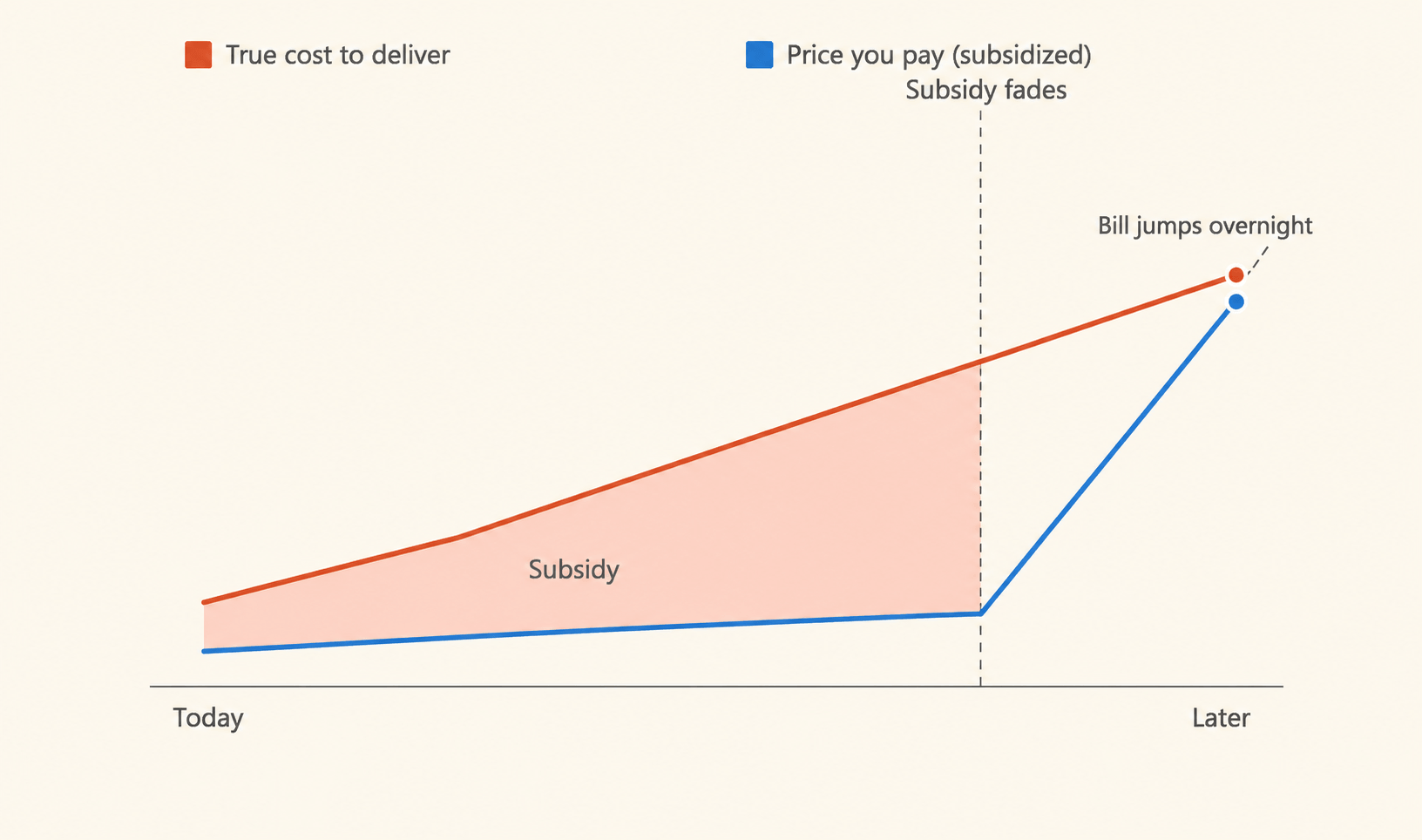
That cheap rate you’re paying isn’t what it actually costs to run the model behind it. It’s held down by investors. AI companies are pouring in enormous amounts of funding to win users, and they’re absorbing much of the real cost of every query to keep the sticker price low. You’re on a subsidised rate, the same way food-delivery apps once sold you ₹99 meals that plainly cost more than that to make and deliver.
Subsidies like that don’t last forever. They last until investors want their money back. When that turns, prices start moving toward what the service really costs.
And what it really costs is rising underneath. These models run on serious computing power, housed in data centres that draw electricity and use water for cooling. Both cost money, and both are getting more expensive. McKinsey estimates data centres will go from using under 4% of all US electricity today to nearly 12% by 2030, a jump in demand that pushes power prices up. Bloomberg has reported that AI data centres are already straining local power grids and driving up electricity costs in the areas around them.
Put those together, and the picture gets uncomfortable. The price you pay is being held artificially low, while the true cost of delivering it climbs. When the subsidy fades and real pricing surfaces, with your usage already sky-high and your teams unable to picture working any other way, the bill won’t nudge. It’ll jump.
What AI Actually Made Cheaper: Building the Plumbing
Step back from the panic, because there’s a genuinely good use of AI hiding in here, and it isn’t the obvious one.
Long before AI, companies automated boring work with rules. If an order is from a repeat customer, tag it gold. If a ticket says “refund,” send it to billing. This is old, boring technology, and it worked fine. The catch was that building it was miserable. Someone had to wire up every rule by hand. It broke the second anything changed. It needed constant babysitting. Most smaller companies never bothered.
This is where AI is quietly brilliant. It’s very good at building and connecting that plumbing for you. You describe what you want in plain English, and AI helps assemble the rules, wire the tools together, and patch them when they break. The fiddly part of automation gets far easier.
Notice the difference, because your bill depends on it. Used this way, AI helps you build the automation once. After that, the automation runs on its own, cheaply, without calling an expensive AI model every single time. That is a world apart from pointing an AI model at a repetitive task and paying it to rethink the same simple decision over and over, forever.
The One Question That Sorts Every Case
If you remember nothing else here, remember this test. It settles most “should we use AI for this?” arguments in about ten seconds.
Ask: can a clear rule decide this?
If yes, the task follows fixed logic, the same input always producing the same right answer, it’s a job for automation. Sorting orders, routing tickets, flagging duplicates, pulling a standard report. Let AI help you build that automation if you like, then let the automation run it for almost nothing. Paying an AI model to make a decision a rule could make is the most common way companies quietly overpay.
If no, the task needs judgment, a forecast, an interpretation, the kind of thing where a person would say “it depends”, that’s where AI earns its cost. Writing a genuinely tailored reply. Reading messy, inconsistent customer feedback and spotting the pattern. Creating something new. No rulebook captures these, and they are worth paying for.
That’s the entire framework. Decisions a rule can make go to automation. Decisions that need judgment go to AI. Everything else in this article is detail hanging off that one line.
Do You Even Need to Track This Yet? Two Filters
Framework in hand, Aditi still had a practical question: does AI cost need its own dashboard, its own owner, its own monthly review? Not always. Building all of that for a tiny, occasional use of AI wastes everyone’s time. Two quick filters tell you whether it has earned the attention.
Filter one: is AI inside something core, or off at the edges? If AI runs in a core part of the business, the thing that touches customers, drives sales, or makes the product, its cost grows as you grow, and it’s worth watching. If it’s someone occasionally cleaning up an email, it isn’t. For Aditi, AI in customer support and ad production is core. AI tidying up her assistant’s meeting notes is not.
Filter two: what slice of your tech spend is it eating? Pull the real number. If AI is a rounding error next to your total technology spend, leave it alone and look again next quarter. Once it crosses a few percent, or shows up as its own visible line, treat it like any real cost: a budget, an owner, and a simple monthly check of planned versus actual. That was exactly the point Aditi’s bill had already reached, which is why it stung.
What Aditi Did That Week
She didn’t buy a tool or hire a consultant. She spent one afternoon.
She pulled three months of AI and software invoices and found the lines that kept climbing. She listed the handful of tasks AI was doing most and ran each through the one question: can a rule decide this? Ticket-routing and report-pulling failed the test, so those moved to plain automation, built, fittingly, with AI’s help, and stopped racking up a charge every time they ran. The real writing and the messy-feedback reading stayed on AI, because they earned it.
Then she checked the share. AI had crossed a few percent of tech spend, so it got an owner and a monthly planned-versus-actual line, like any cost that had started to matter.
You can run this afternoon this week. Find the climbing line. Sort each task with the one question. Move the rule-based work to automation. Keep AI for the judgment calls. Then use the two filters to decide whether it’s big enough to formally track yet. None of this is about using less AI for its own sake. It’s about not paying AI prices for work a rule could do, especially now, while the price you see is still the friendly version.
Frequently Asked Questions
If AI keeps getting cheaper, why is our bill going up?
Because your usage is growing faster than the price is falling. Stanford’s AI Index found the cost per AI task dropped more than 280-fold in two years, and once it felt free, teams used vastly more of it. Total cost is price times quantity, and right now quantity is winning.
Is today's low AI pricing going to last?
Probably not at these levels. Much of the current price is held down by investor money while AI companies chase growth, and the real cost of running these models, driven by rising power and data-centre costs, is climbing underneath. When the subsidy eases, prices tend to drift toward true cost.
How do we decide what should be AI versus plain automation?
One question: can a clear rule decide the task? If yes, it’s automation, which is cheap to run and which AI can even help you build. If it needs real judgment or interpretation, that’s where AI is worth paying for.
When should we start formally tracking AI cost?
When it stops being a rounding error. If AI is a tiny slice of your tech spend, a quarterly glance is enough. Once it crosses a few percent or becomes its own visible line, give it a budget, an owner, and a monthly review.
Give us 30 minutes.
We’ll show you exactly what we’d automate first.
1 - 30-minute call
You walk us through your close cycle, your planning headache, your dashboard problem. We listen more than we pitch.
2 - One-page automation opportunity map
Yours to keep, whether you proceed or not
3 - Pilot scope + fixed quote
If it fits, we scope the 30-day pilot. If not, you keep the map.
We take our profit after you see your benefit.